Cladogram

Organism 1: Chondrilla nucula
Taxonomy
Kingdom: Animalia
Phylum: Porifera
Genus: Chondrilla
Species: C. nucula
Why does it belong in this kingdom?
Chondrilla nucula belongs in animalia because it is eukaryotic, is multicellular, acquires energy through absorption, is motile, and reproduces through sexual reproduction. This organism belongs in the phylum porifera because it is a parazoan organism that is is full of pores and channels for water to flow through, and also doesn’t have a nervous system [75].
General description of the organism
Chondrilla nucula, otherwise known as Caribbean chicken-liver sponge, is a shapeless sponge commonly found in the waters of Bermuda. This organism has a greenish-brownish color, and can grow up to 15 cm. Chondrilla nucula can be found in caves and illuminated habitats, and the color of the chondrilla nucula may change based on how much light is in the environment.. They can also adapt to live in very different environments. Chondrilla nucula has toxins in it that protects it from predators. It is also a very aggressive organism, encrusting many different organisms. This organism is also one of the few organisms in Kingdom Animalia that does not have a nervous system [76].

Organism 2: Common Cuttlefish
Taxonomy
Kingdom: Animalia
Phylum: Mollusca
Genus: Sepia
Species: S. officinalis
Why does it belong in this kingdom?
The common cuttlefish belongs in animalia because its eukaryotic, multicellular, uses ingestion as its mode of nutrition, has a nervous system, is motile, and reproduces with sexual reproduction. This organism belongs in the phylum mollusca because it is an invertebrate, has a mantle with a cavity for breathing and excretion, and has a radula, which is used for feeding [77].
General description of the organism
The common cuttlefish is the largest species of cuttlefish, native to the Mediterranean Sea, North Sea, and Baltic Sea. They live on sand and mud beds to a depth of around 200 meters. The common cuttlefish preys on many organisms, such as bony fish, copepods, crustaceans, gastropods, and octopods. A study done in 2008 revealed that if a cuttlefish embryo was visually exposed to a specific predator, it will later hunt that predator later in life, even more so than the more common predators of cuttlefish [78].

YouTube video #4: Common cuttlefish
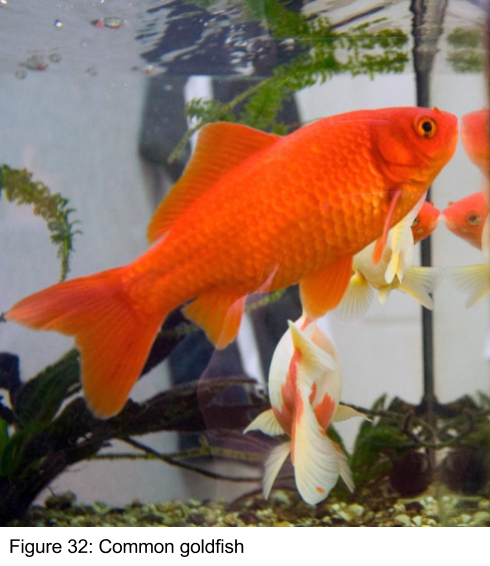
Organism 3: Goldfish (Classroom animal)
Taxonomy
Kingdom: Animalia
Phylum: Chordata
Genus: Carrasius
Species: C. auratus
Why does it belong in this kingdom?
The goldfish belongs in Kingdom Animalia because it is multicellular, eukaryotic, acquires energy through ingestion, has a nervous system, is motile, and reproduces through sexual reproduction. This organism belongs in the phylum Chordata because it possesses a notochord, a hollow dorsal nerve cord, pharyngeal slits, and an endostyle, which are all traits of organisms belonging to the phylum Chordata [79].
General description of the organism
The goldfish is a freshwater fish native to east Asia, where it has been bred for over a thousand years. Although the most common variety of goldfish is the small, orange variety, goldfish can come in many different colors and shapes, such as white, yellow, red, and brown. Goldfish are very sociable creatures, traveling in schools when going to any location. Goldfish are very friendly to each other, rarely another goldfish. In the wild, goldfish eat crustaceans, insects, and plants. Goldfish are commonly used to reduce mosquito populations in bodies of water, which prevents the spread of West Nile Virus [80].