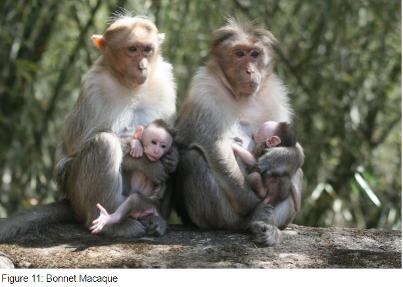
Organism 1: Bonnet Macaque
Taxonomy
Domain: Eukarya
Phylum: Chordata
Genus: Macaca
Species: M. radiata
Why does it belong in this domain?
It belongs in the domain Eukarya because it shares characteristics such as membrane bound cells and RNA that is unique to Eukaryotes with other organisms in this domain [56]. It also belongs in Eukarya because it is multicellular, eukaryotic, has a nervous system, is motile, and reproduces using sexual reproduction.
General description of the organism
The Bonnet Macaque is a species of monkey, specifically indigenous to Southern India. Usually they can grow up to 35-60 centimeters in length with a tail of similar measurements [53]. Bonnet Macaques have been known to eat nuts, seeds, a large range of different fruits and even invertebrates. They have also been known to eat food given to them by humans. Their behavior has also been shown to be very unique and often includes lip smacking, where they show their frustration by quickly closing their mouth to make a loud sound [54]. And by “showing their teeth” they can warn others about attacks by animals such as pythons and big cats.
Bonnet Macaques have a unique social structure which consists of many different leaders. Often the male leaders will fight with one another in order to gain a higher ranking and impress females [55]. Usually they live up to 25-35 years old, and they are ranked as “least concerned” of the IUCN list of endangered species.
Organism 2: Pacific Sea Nettle
Taxonomy
Domain: Eukarya
Phylum: Cnidaria
Genus: Chrysaora
Species: C. fuscescens
Why does it belong in this domain?
The Pacific Sea Nettle belongs in the domain of Eukarya because it has membrane bound organelles and has RNA that is unique to Eukarya [57]. It also belongs in Eukarya because it is multicellular, it is eukaryotic, it is motile, it has a nervous system, and reproduces through sexual reproduction.
General description of the organism
The Pacific Sea Nettle is a species of scyphozoan that lives in the East Pacific Ocean. They can be found as far north as Canada and as far south as Mexico. They are easily distinguished by their golden and red tint, and along with relatively easy caring, they are a favorite in many aquariums. Recently, they have become over abundant and this is thought to be a result of climate change [55].
The bell or “cap” of a Pacific sea nettle can be up to three feet in diameter, and including their tentacles, can be over three times that. The largest specimen of Pacific Sea Nettle ever was 16 feet long. They are carnivores and use their tentacles to catch organisms such as plankton and small fish [56]. When caught, the tentacles release a poison that kills their prey; however, the poison is not lethal to humans [58]. The predators of Pacific sea nettles are large fish and birds [59].

