Organism 1: Rigidoporus Ulmarius
Taxonomy
Kingdom: Fungi
Phylum: Basidiomycota
Genus: Rigidoporus
Species: R. ulmarius
Why does it belong in this kingdom?
Rigidoporus Ulmarius belongs in Fungi because it acquires nutrients by absorption, does not have a nervous system, and is not motile.
General description of the organism
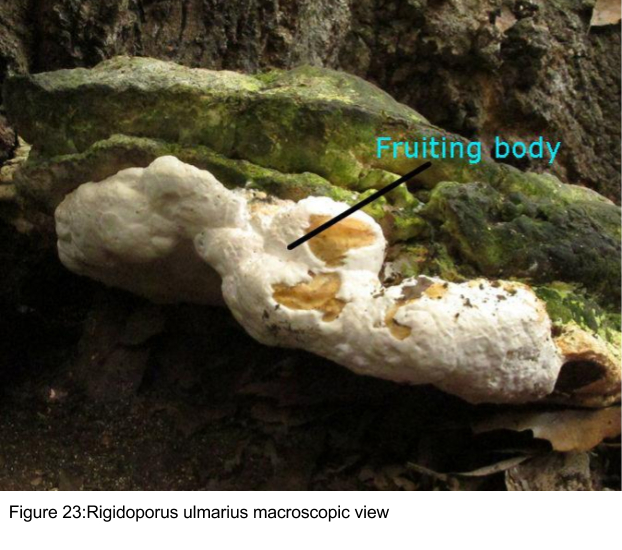
Rigidoporus ulmarius is a plant pathogen found mainly on broad-leaved trees, and especially on elm trees. A plant pathogen is an organism that causes a disease on a plant. The fruiting bodies of Rigidoporus ulmarius are white, bumpy, and very hard to break. Older fruiting bodies may be covered in green algae, or covered with moss or leaves. In 2003, a fruit body of Rigidoporus ulmarius was found that was the largest fungal fruit body up until that point in time, measuring 59 by 52 in in diameter, and having a circumference of 167 in [70].
Organism 2: Sarcoscypha coccinea
Taxonomy
Kingdom: Fungi
Phylum: Ascomycota
Genus: Sarcoscypha
Species: S. coccinea
Why does it belong in this kingdom?
Scarlet elf cup belongs in fungi because it is a eukaryote, is not motile, eats through absorption (saprotrophic nutrition) and has no nervous system.
General description of the organism
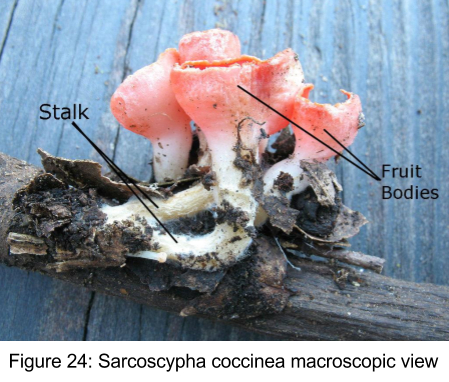
Sarcoscypha coccinea is a species of fungus found in Africa, Asia, Europe, North and South America, and Australia. Sarcoscypha coccinea grows on decaying sticks and branches in damp spots on forest floors. The fruit bodies are shallow and cup-shaped, and the insides of them are red. Sarcoscypha coccinea has been used as a medicine by the Oneida Indians and other tribes of the Iroquois Six Nations. The fungus would be ground up into a powder, and was applied to the navels of newborn children who weren’t healing after having their umbilical cord severed [71].