Organism 1: Trypanosoma Brucei
Taxonomy
Kingdom: Protista
Phylum: Euglenozoa
Genus: Trypanosoma
Species: T. brucei
Why does it belong in this kingdom?
Trypanosoma brucei belongs in Protista because it is microscopic, eukaryotic, doesn’t have a nervous system, and is motile.
General description of the organism
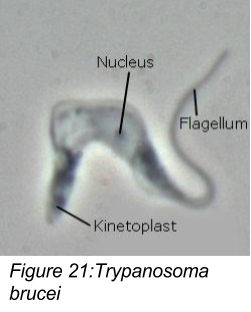
Trypanosoma brucei is a parasitic protist, mainly present in Africa, which is a very hot environment. It has an elongated and narrow body, with a flagellum for motility. Trypanosoma brucei has many of the same organelles as humans, such as a nucleus, mitochondria, endoplasmic reticulum, Golgi apparatus, and ribosomes. In addition to these, there is also an organelle called the kinetoplast, which functions as a mitochondria [64].
Trypanosoma brucei is well-known for causing African trypanosomiasis, otherwise known as African sleeping sickness, in humans. Immediately after getting African sleeping sickness, a person will experience fevers, itchiness, headaches, and joint pains. After a few weeks however, the person will start to have confusion, numbness, and trouble sleeping. If a person is not treated, it is likely that they will die [65]. In animals, trypanosoma brucei will give animal trypanosomiasis, which causes amnesia and weight loss in animals [66].
Organism 2: Plasmodium Falciparum
Taxonomy
Kingdom: Protista
Phylum: Apicomplexa
Genus: Plasmodium
Species: P. falciparum
Why does it belong in this kingdom?
Plasmodium falciparum belongs in protista because it is microscopic, eukaryotic, doesn’t have a nervous system nervous system, and is motile.
General description of the organism
Plasmodium falciparum is a protozoan parasite found in female mosquitos. Plasmodium falciparum has a nucleus, vesicles, rough endoplasmic reticulum, microtubules, and ribosomes. There is also an organelle called a rhoptry which releases important enzymes during the penetration process between the carrier and the host [67]. Plasmodium falciparum is a lot more common in sub-Saharan Africa, which is a hot environment, than it is in the rest of the world [68].
Plasmodium falciparum is one of the species of Plasmodium that causes malaria in humans. This species of Plasmodium causes the most dangerous type of malaria, falciparum malaria. Malaria is the most significant parasitic disease in humans, killing hundreds of thousands of people a year. Over 75% of the deaths in sub-Saharan Africa due to malaria were caused by falciparum malaria. Symptoms of malaria include chills, fever, and sweating, which usually occur a few weeks after being bitten [69].

